




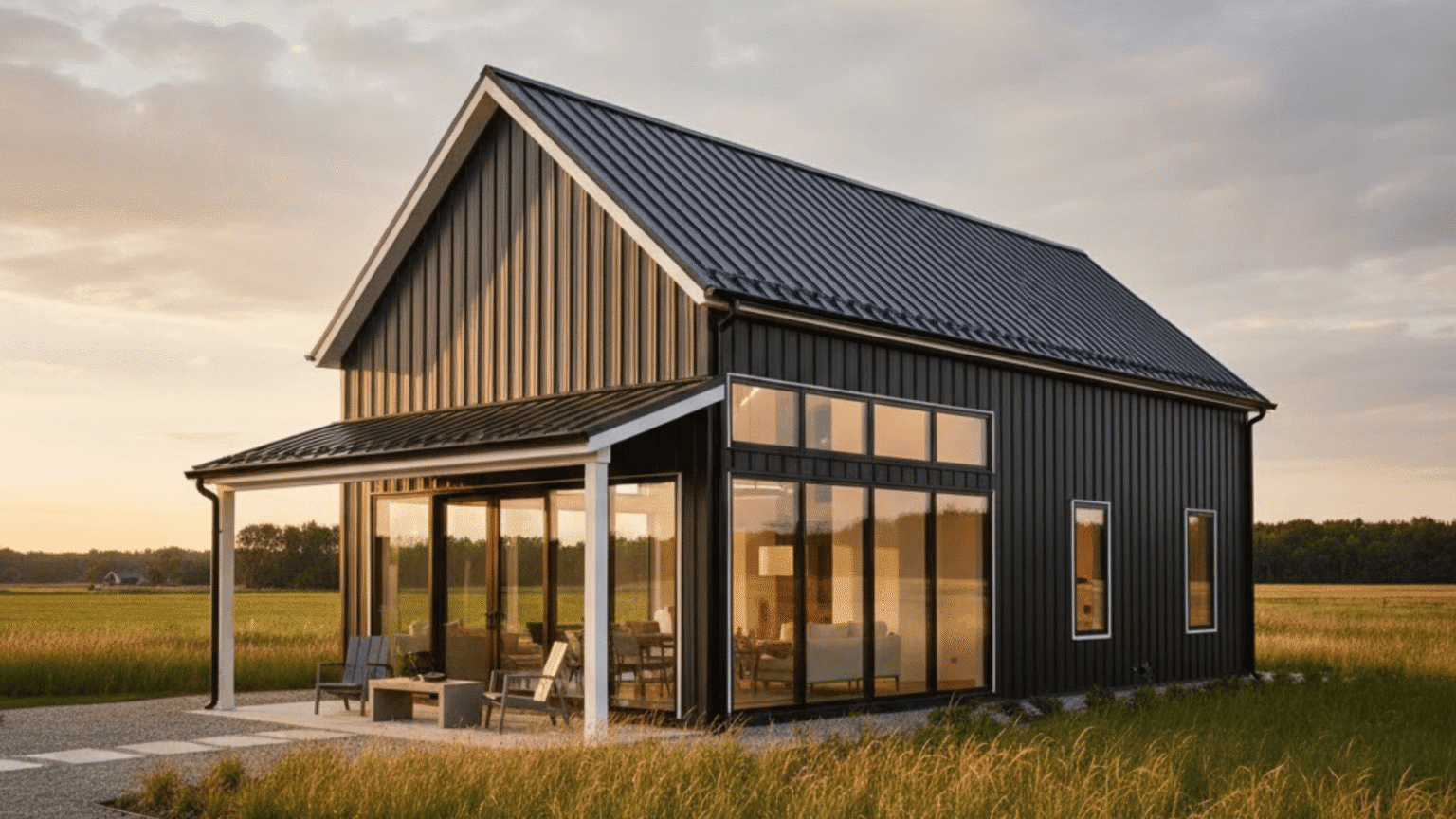
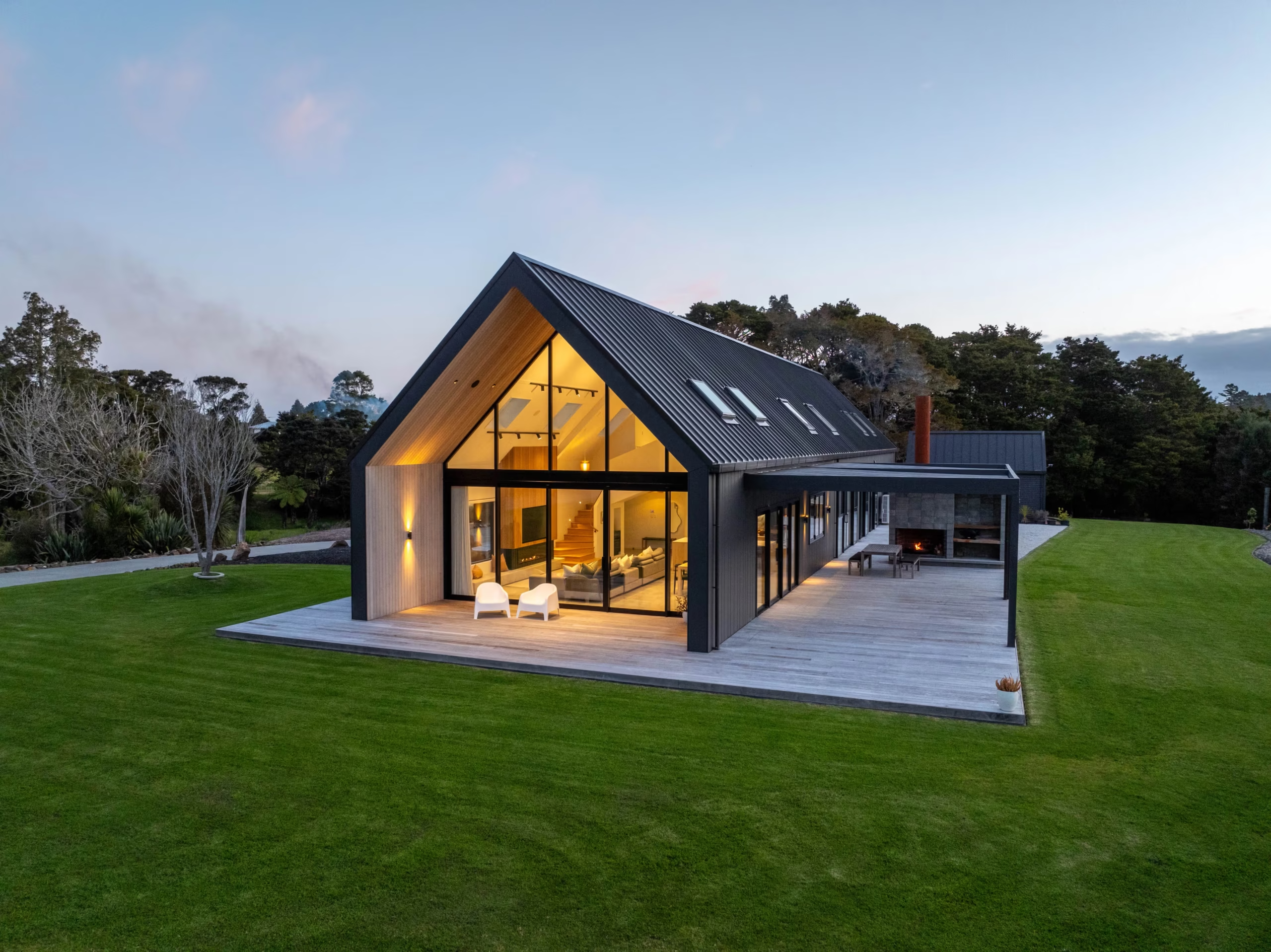
A premium modern barn is actually the most sought-after type of single-family home in Poland in 2026. Over 1,200 catalog designs, hundreds of custom-built projects, and prices starting from 1.69 million PLN near Warsaw. This is not an adaptation of an old barn, but a conscious neo-vernacular design: a rectangular form, elongated floor plan (80–200 m²), a 35–45° gable roof without eaves, and asymmetrical glazing spanning the full height from floor to ridge.
Luxury here means “less, but better”: tailor-made materials, technology hidden in the background, light as the main element of the composition.
Why does this style dominate in 2026?
Because it works on many levels at once. Family living (privacy, open plan, lots of light), vacation use (the “wow” effect on Airbnb without flashy details), and simply well-being: corten, shou sugi ban, large glass panels, smart home so seamlessly integrated you don’t even notice it. This isn’t a visual trend, but rather a response to fatigue with decoration. People want a home that breathes with them, not one that constantly requires playing the role of “luxury property owner.”
Form, materials, and premium-class technologies
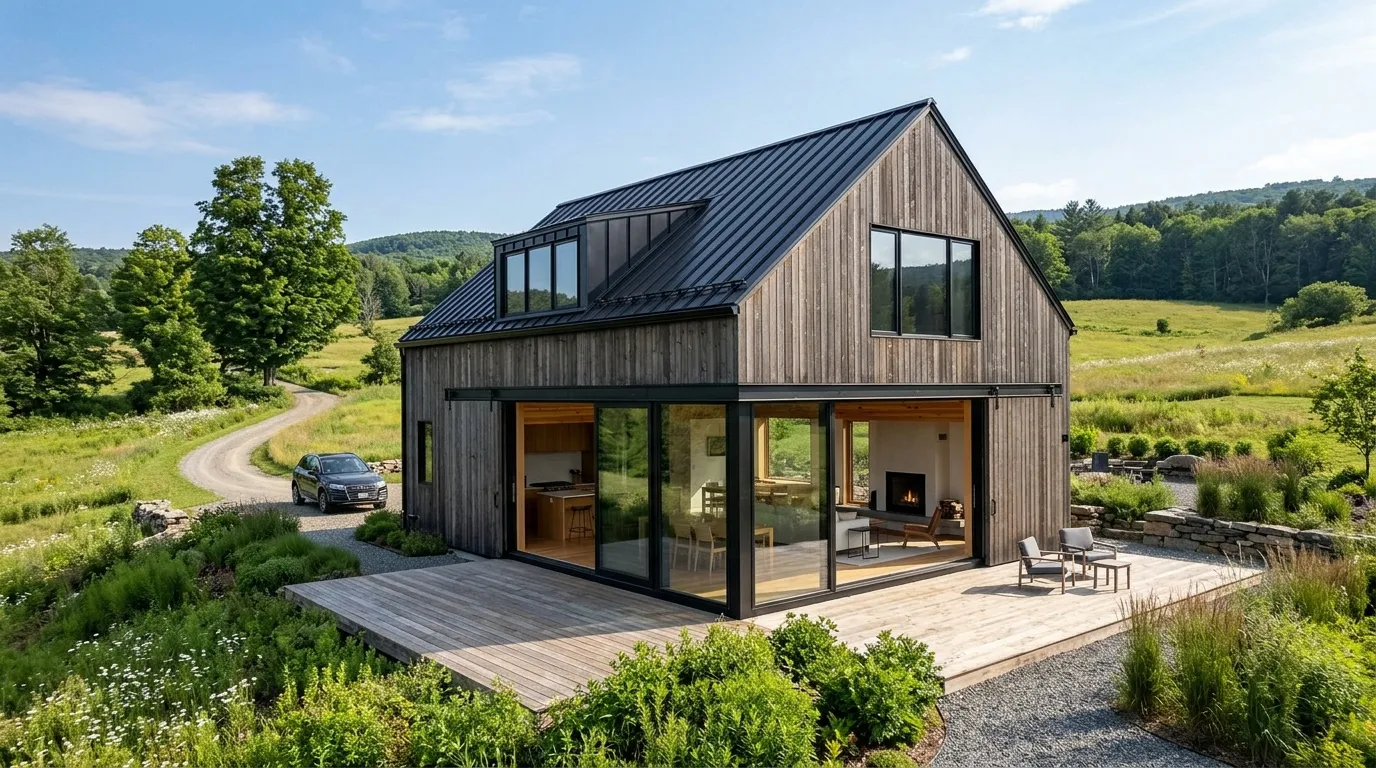
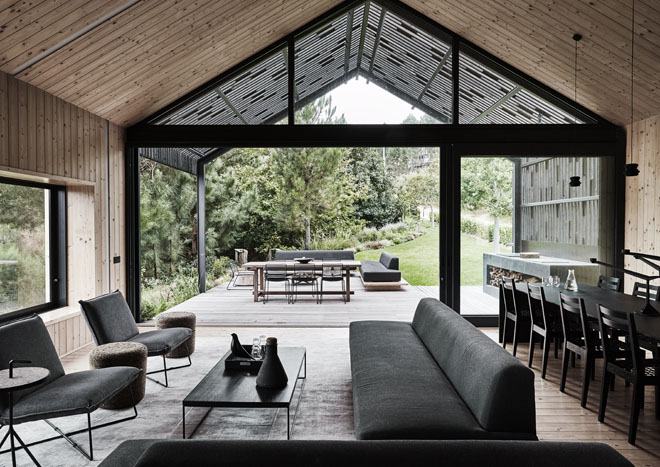
A contemporary premium barn is typically a simple rectangular structure with a gable roof sloped at 35-45°. Most designs feature the so-called “eavesless roof,” which emphasizes the minimalist character. The façade is dominated by a single large glazing, sometimes stretching from floor to ridge. Inside, you get a “cathedral ceiling” with a height of 7-10 meters and an open space, often with a mezzanine. The absence of load-bearing walls allows for flexible arrangements, but requires a carefully designed steel or wooden structure.
Materials and energy
The façades are finished with charred larch boards (shou sugi ban), corten steel, or brick arranged in a 3D pattern. These are durable and visually interesting materials. The roof is covered with standing seam metal sheets. The windows are triple-glazed units with a Uw below 0.8 W/(m²·K), often featuring selective glass to prevent overheating. Insulation is 30-40 cm thick, which, combined with an air-to-water heat pump, mechanical ventilation with heat recovery (MVHR), underfloor heating, and photovoltaics, results in energy consumption at the level of 15-30 kWh/m²/year, meeting the passive standard.
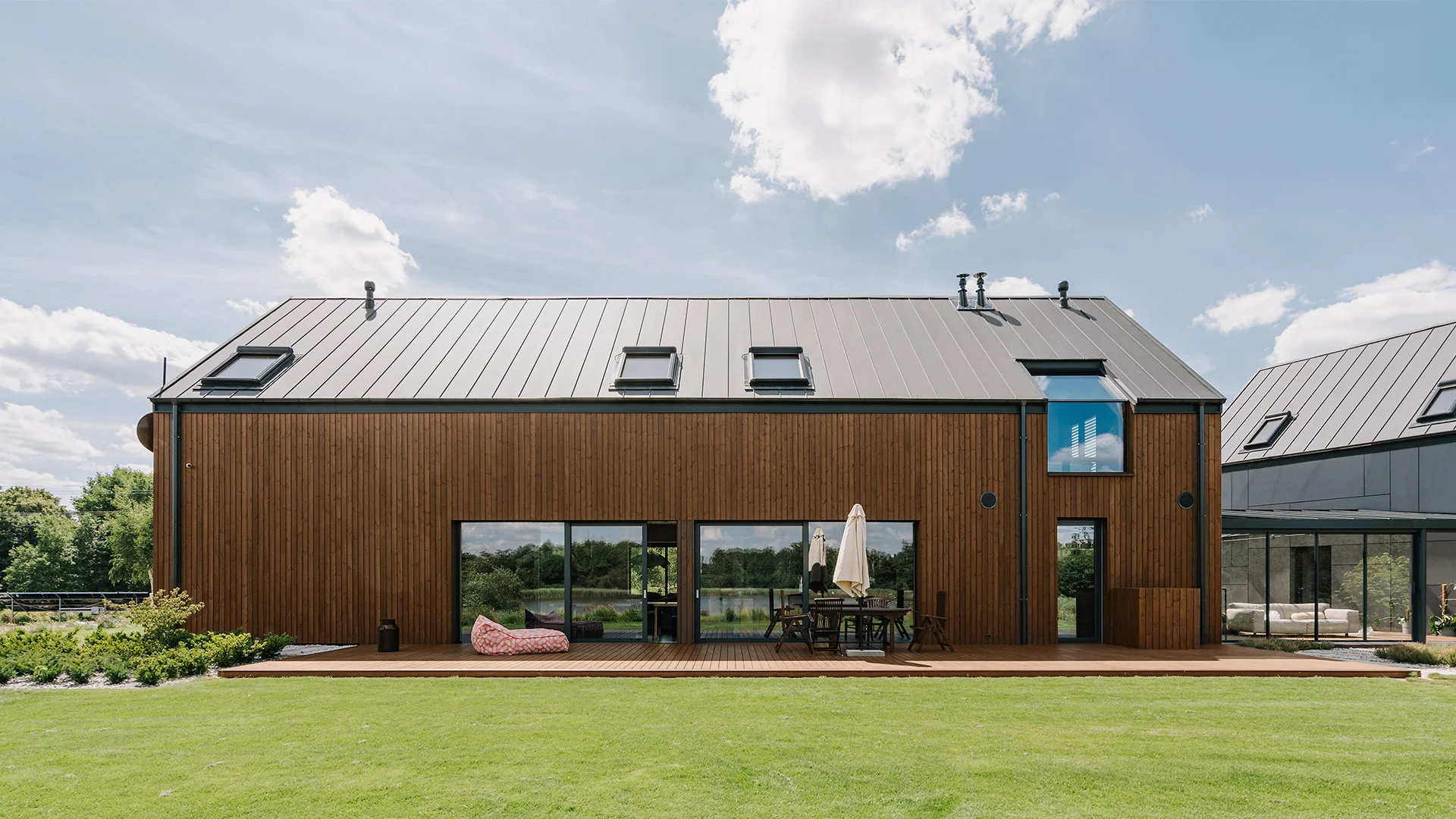
Risks? Echo in rooms with high ceilings (solved by interior acoustics), lack of privacy with glazing (blinds, brise-soleil), possible overheating in summer (selective glazing, night ventilation). With proper design, everything can be managed.
Costs, implementation models, and the market in 2026
Are you wondering how much you really need to spend on a modern barn-style house? In developer standard, the cost is around 5,765 PLN/m². For a popular size of 120 m², this means a budget of 670,000–740,000 PLN net. If you want a turnkey finish, the amount increases to a range of 862,000–1,000,000 PLN. That’s quite a wide range, which mainly depends on the quality of materials and smart home systems.
Prefab vs. traditional
Here, the differences are truly striking. Prefabricated solutions (such as Rest House 88) offer a closed shell for around 350,000 PLN, and a developer finish for 455,000 PLN. More importantly, the completion time is just 3–6 months. Traditional technologies? Easily 12–18 months from foundation to roof. DMK Budownictwo even offers a mobile Granero Loft variant with an area of 35 m², which shows how dynamic this market has become in 2026.
| Model | Lead time | Indicative budget |
|---|---|---|
| Prefab (SSZ) | 3-4 months | 350 thousand PLN |
| Prefab (developer) | 5-6 months | 455 thousand PLN |
| Traditionally | 12-18 months | comparable or higher |
The market is now confirming this. Extradom alone offers over 1,213 designs, with the most popular sizes ranging from 100 to 150 m². It’s also worth checking out offers from companies such as Modularen, Z500, Archon+, HomeKONCEPT, or Wolf Haus. The premium segment? Near Warsaw, prices for luxury plots with a barn house-style villa start at PLN 1.69 million.
Between Tradition and the Future: A Mature Choice
The simplicity of the barn’s form is no coincidence; it reflects a deep understanding of what will endure over the years. In the premium segment, it’s no longer just about flashiness—what matters is predictability: operating costs, durability of form, and energy efficiency. Technology and comfort do not exclude the archetype; on the contrary, they give it new value.
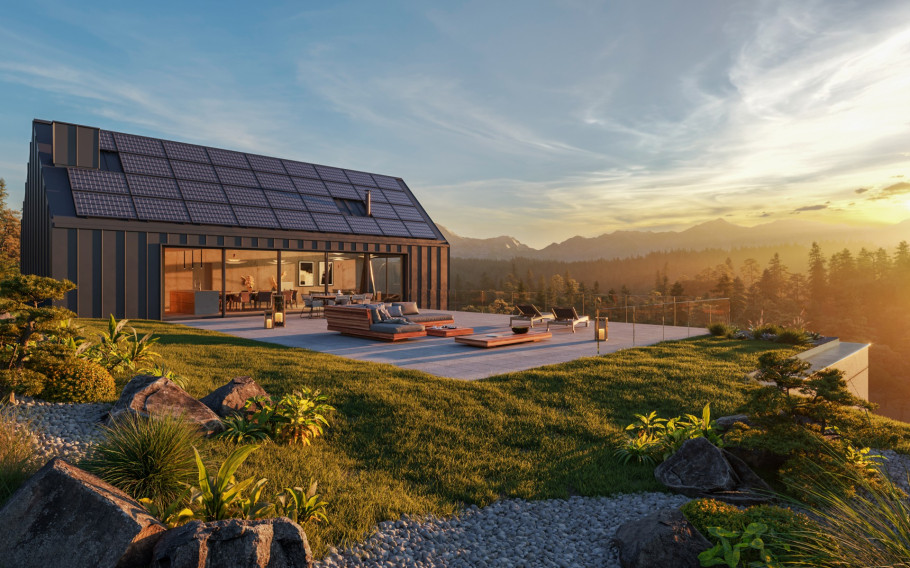
The market has matured enough to appreciate what once might have seemed too austere. A modern barn in a premium version is not a passing whim, but a long-term investment in peace and aesthetics that never get boring. A form proven over centuries, equipped for the 21st century, is simply sensible luxury.
Mark
Luxury Reporter editorial team
