




An extraordinary manuscript up for auction. The Grail from Clermont-Tonnerre is looking for a new owner. A medieval bestseller that has survived seven centuries. 700 years of King Arthur’s history at Christie’s auction attracts collectors’ attention. It sparks the imagination.
On July 8, London will soon become a meeting place of history, art, and legend. At the Christie’s auction house, a unique auction titled Valuable Books and Manuscripts including Cartography will take place. One of the most important items will be the priceless medieval manuscript known as the Graal de Clermont-Tonnerre.
The estimated value of the manuscript ranges from 1.5 to 2 million pounds. However, for collectors, its significance goes far beyond its price. It is one of the rarest surviving witnesses to the birth of the legend of the Holy Grail, King Arthur, and the wizard Merlin. A story that has inspired writers, artists, and creators of popular culture for centuries.
The manuscript was created around 1290–1310. It is one of only three known copies currently in private hands, making it a unique item on the global collectors’ market.
A book that looks like a treasure from a legend
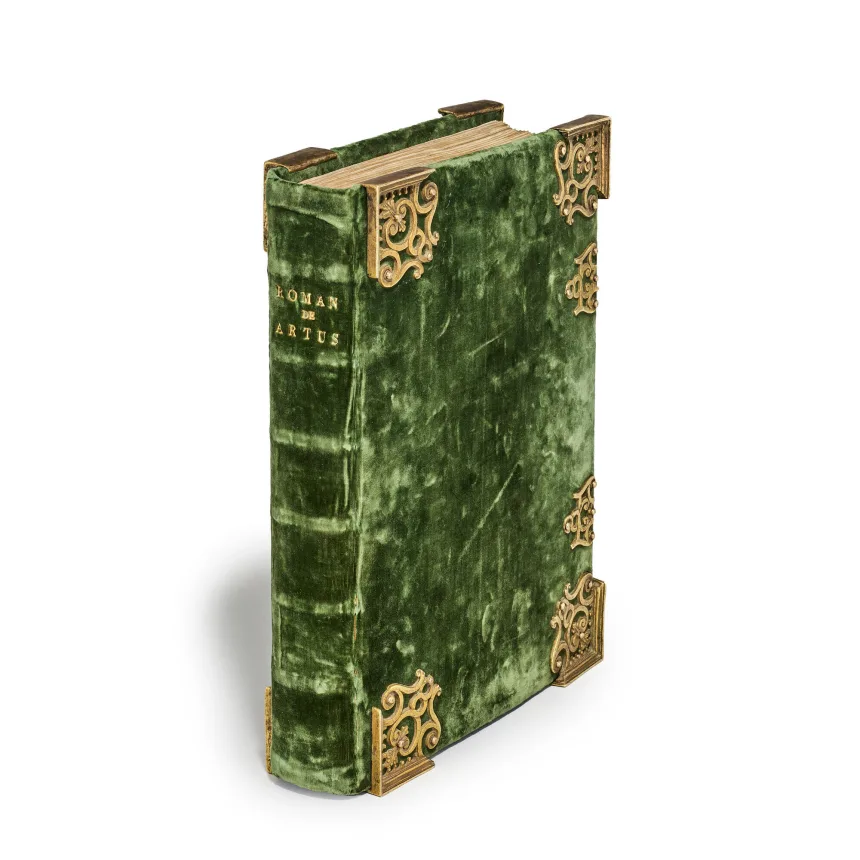
The very form of the manuscript is truly impressive. The book has the size and weight of a medieval Bible. Its wooden covers are clad in deep green velvet reminiscent of ancient moss, and the whole is adorned with massive brass fittings. Once closed like a precious travel chest, it was an object meant to protect not only the text but also the unique value of the story contained within.
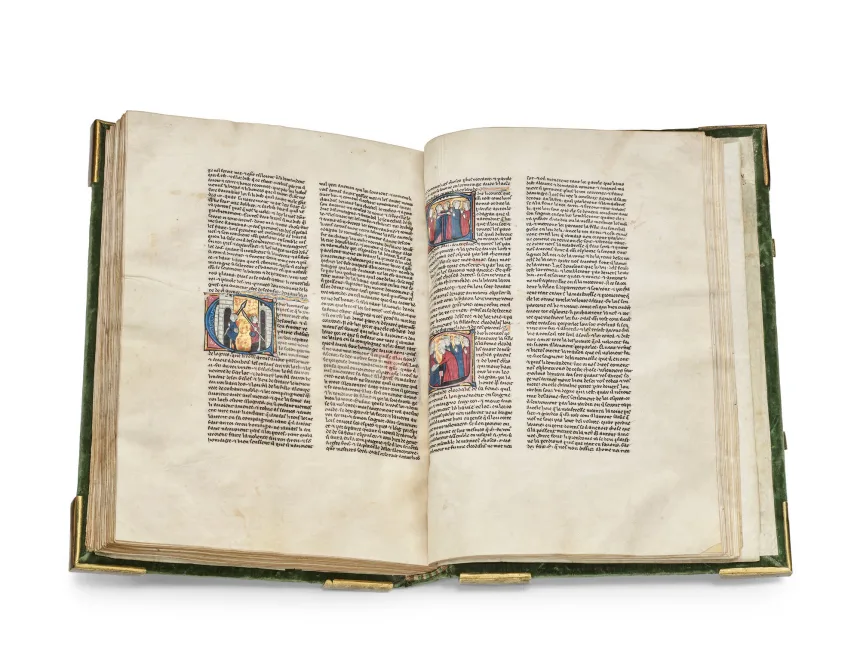
On the spine, there is a gold inscription Roman de Artus — indicating the subject of the work: the world of King Arthur and his knights.
However, the true value of this book lies within. The manuscript contains three interconnected stories: the history of the Holy Grail, the tale of Merlin’s life, and a description of the first, conflict-filled years of Arthur’s reign.
The Grail that changed the history of the legend
For the modern audience, the Holy Grail almost automatically means the cup from which Jesus is said to have drunk during the Last Supper. However, it was not always depicted this way.
One of the main reasons why the Clermont-Tonnerre manuscript attracts the attention of researchers and collectors is the fact that it contains one of the most important versions of this story. It was Robert de Boron—the author whose work forms the basis of the first two parts of the manuscript—who was the first to give the Grail a Christian meaning, presenting it as the chalice of Christ.
This vision forever changed Western culture. Later novels, films, and works of art — from Arthurian legends to modern productions such as “Indiana Jones and the Last Crusade” or “The Da Vinci Code” — draw on the image of the Grail that originated in precisely these kinds of medieval tales.
126 miniatures that bring Artur’s world to life
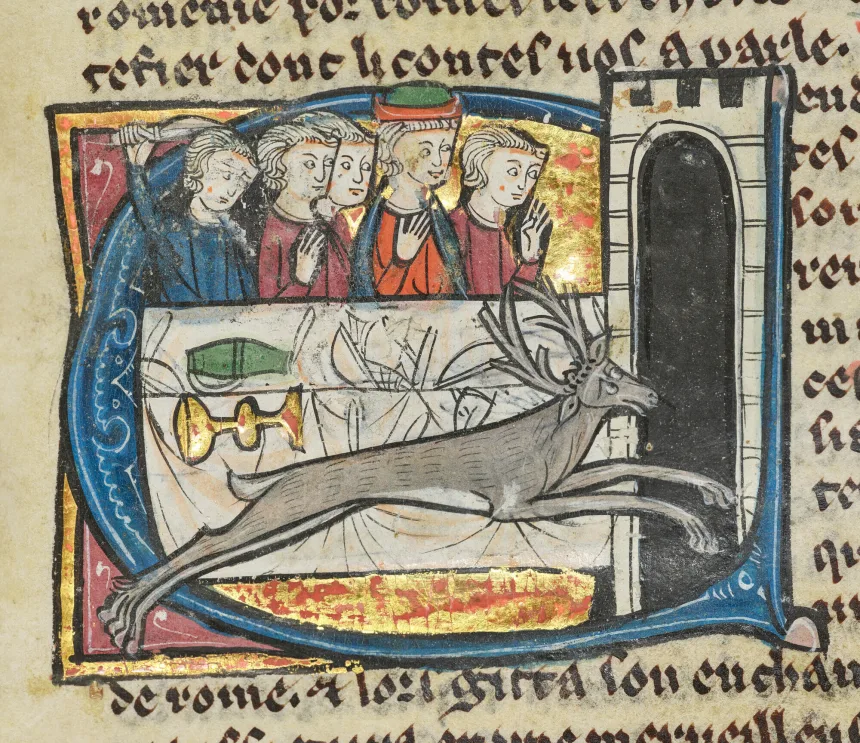
Not only the text determines the uniqueness of the manuscript. The book is adorned with as many as 126 illuminated initials, meaning decorative first letters of chapters, within which miniature narrative scenes are hidden.
Each of them is a small work of art. They depict the heroes of the legend: Joseph of Arimathea, Merlin, the future guardians of the Grail, and events from the youth of King Arthur. The illustrations were created in Metz. They are associated with the circle of the artist known as the Master of the Apocalypse of Liège, one of the most fascinating illuminators of the late 13th and early 14th centuries.
For collectors, such manuscripts are more than just antique books. They are tangible traces of an era when stories did not yet circulate in printed editions, but were copied by hand and decorated by artists.
Merlin — the wizard and archetype
The second major protagonist of the manuscript is Merlin — a figure who remains to this day one of the most recognizable wizards in European culture.
In the version presented in the Grail by Clermont-Tonnerre, he is not just a wise old man with a staff and a gray beard. He is a hero full of contradictions: a visionary, a strategist, a shapeshifting mage, but also a mysterious and ambiguous figure.
His ability to transform into animals and humans was eagerly depicted by medieval illustrators. In the pages of the Merlin manuscript, he appears, among others, as a deer, a shepherd, or a knight leading Arthur’s troops.
It is precisely this complex portrait that made Merlin the archetype of the wizard later present in literature. From Prospero in William Shakespeare’s “The Tempest” to Gandalf and Dumbledore.
Why are collectors interested in this manuscript?
The greatest interest in the Grail from Clermont-Tonnerre stems from the combination of several exceptionally rare features. It is at once an outstanding work of medieval book painting, an important document in the history of literature, and one of the key records of a legend that has remained popular for seven centuries.
On the collectors’ market, the most valuable items are those that tell a story greater than themselves. This manuscript is not just an old book. It is also a witness to the moment when medieval tales began to shape the imagination of all of Europe.
When the Christie’s auctioneer’s gavel falls in July 2026, the new owner will receive not only a parchment written over seven centuries ago. They will receive a piece of a legend that is still alive.
Because the true power of the Grail from Clermont-Tonnerre lies not only in its age. It lies in the fact that after 700 years, it can still tell a story the world still wants to hear.
